01Mistake 1: medium flowing backwards
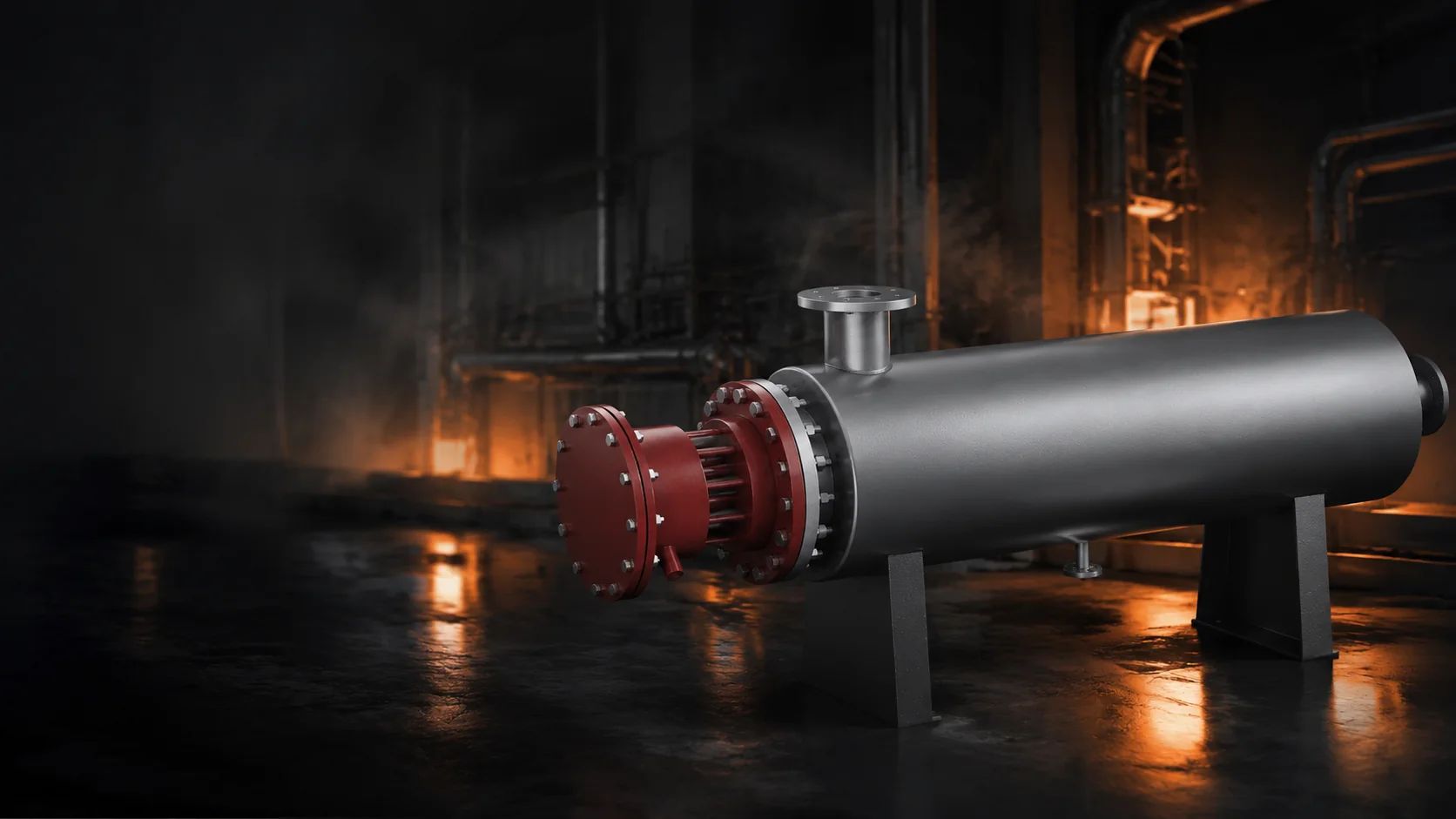
Most pipeline heaters contain baffles or directional internals; the arrow on the shell shows the flow direction. Installed backwards, velocity distribution degrades and local zones stagnate — sluggish control at best, wall overheating and fouling at worst. Verify the arrow against pipe routing before lifting. For lines that can genuinely flow both ways, confirm with the manufacturer before ordering.
02Mistake 2: temperature sensors in the wrong place
Too close to the outlet
Sensing right at the heater outlet amplifies turbulence and hunts the control loop. Place the control sensor 3–5 pipe diameters downstream, where the stream is mixed.
Insertion too shallow
A thermowell that stops short of the flow centreline reads the cool boundary layer, under-reports the true medium temperature and quietly lets the heater over-deliver.
Control and protection sharing one point
The over-temperature protection must have its own sensor — typically at the element wall inside the heating section — separate from the control loop. Shared sensing defeats the protection.
03Mistake 3: no minimum-flow protection
'There's a pump, so there's flow' is the most dangerous assumption in this business. A closed valve, a blocked strainer or pump cavitation collapses the flow in seconds and the heater is at dry-fire edge instantly. Fit a flow switch or differential-pressure transmitter at the heater inlet that cuts heating and alarms below minimum flow. That interlock costs a fraction of a percent of the heater — and most incidents trace back to exactly this missing piece.
04Mistake 4: pipe stress hanging on the flanges
Misaligned pipework pulled into place, thermal growth uncompensated — the resulting forces land directly on the heater flanges: gasket leaks at best, deformed or cracked flanges at worst. Align flanges naturally (bolts must slide in freely), and fit expansion bellows or loop legs on long hot runs. On large bore and high ΔT systems this is not a detail, it is the failure mode.
05Mistake 5: no venting and draining
Air trapped at system high points becomes a dry pocket the moment it passes the elements. Sludge in water systems settles at the bottom of the heating section and overheats it. Mount heaters with a slight slope, vent at the high point, drain at the low point — the basics of liquid systems. Two-phase or steam-mixed lines also need hammer protection: warm up slowly, open valves gradually.